I'm not sure about y'all, but this school year is flying by! I cannot believe we are less than a month away from celebrating Valentine's Day! After a successful Christmas product link up, I want to continue the trend this week by hosting my second link up with a Valentine's Day product theme!
All you have to do is find your favorite Valentine's Day products, copy the link to your store, and share below! Share as many links as you'd like, but I humbly ask that you share at least one freebie so we can promote our stores while saving other teachers some green.
Please feel free to share my blog link with other TpT sellers or teachers who are looking for awesome Valentine's Day classroom resources!
I hope each of you find resources you can utilize in your classrooms! You can follow me on twitter and instagram @sassypeteach for my latest product updates! You can also check out my store in the top banner for some awesome Valentine's Day resources (with more coming soon)!
Have an amazing week teacher friends!
January 17, 2017
Valentine's Link Up: All Subjects Welcome!
January 10, 2017
How to Teach a Middle School Bowling Unit
Bowling is an excellent indoor recreation sport that allows students to learn more about skill-related fitness components, as well as etiquette, sportsmanship, and cooperative skills! There is no better time to teach bowling than right now in the cold of winter. Your classes are already indoors and in most cases, you're forced to combine with other classes due to limited space. Bowling is a wonderful sport that can accommodate each of these circumstances while still getting students moving and grooving! So if you're looking for advice on how to start your own bowling unit or if you're looking for new ideas to spice up your existing unit, then keep reading! If you're looking for an awesome freebie, you'll find access to my manual scoring assessment at the end of this post!
Before Getting Started:
It's important to analyze your equipment and potential equipment needs before beginning any unit in your classroom. It's also essential to be creative, especially if you don't have "real" bowling equipment. My school is very fortunate to have access to authentic bowling pins for 10 lanes, 10 rubber or plastic bowling balls {I do not recommend purchasing plastic bowling balls - more on that later}, and mats that act as bumpers at the far end of each lane. Your school may not have this equipment (and I've been there before) so you may need to be more creative.
If you have bowling equipment already, fantastic! If you don't currently have bowling equipment, but you have the resources to purchase equipment, here are my top recommendations for bowling equipment:
Pins:
Prior to class, I would have reviewed peer feedback. After my students have completed the instant activity and fitness activity for the day, I quickly review and demonstrate the basic skill learned in day one and hand back their peer feedback from the previous class. On day two, I add station task cards to each lane. Students work through various setups throughout class and track their progress. For example, a station task card looks like:
Day five is assessment day and I have been notifying my students about this every day leading up to it. My assessment style is informative and, in my opinion, always students to test in a comfortable environment without fear of making mistakes.
Before Getting Started:
It's important to analyze your equipment and potential equipment needs before beginning any unit in your classroom. It's also essential to be creative, especially if you don't have "real" bowling equipment. My school is very fortunate to have access to authentic bowling pins for 10 lanes, 10 rubber or plastic bowling balls {I do not recommend purchasing plastic bowling balls - more on that later}, and mats that act as bumpers at the far end of each lane. Your school may not have this equipment (and I've been there before) so you may need to be more creative.
If you have bowling equipment already, fantastic! If you don't currently have bowling equipment, but you have the resources to purchase equipment, here are my top recommendations for bowling equipment:
Pins:
- Hollow Bowling Pins from Flag House | $44.50 per 10 piece set.
- Weighted Bowling Pins from Flag House | $52.00 per 10 piece set.
Balls:
- Polyvinyl 5lb from Flag House | $44.50 per ball
- Polyvinyl 2.5lb from Flag House | $27.75
- Weighted 2.5lb Foam from Flag House | $16.50
- Rainbow Striker Rubber Bowling Ball by Gopher | $34.95 - $54.95 (individual) or $199 (set of six)
Complete Sets:
- 10 Pin 5lb Ball Set from Flag House | $89.00
- UltraPin Bowling Sets from Gopher | $69.95 - $135.00
You can certainly find cheaper options, but what I love about Gopher is their lifetime replacement guarantee. When an item breaks or wears down, they will replace it, no questions asked. My department chair and I do this frequently. Flag House also has the widest variety of options.
I'm sure some of you are looking at these prices and thinking, "Wow, these all look great, but I simply don't have the budget to purchase these items!" You're in luck because there are a ton of items you probably already have in your storage closet that can be just as effective!
![]() |
| Courtesy of Pinterest https://www.pinterest.com/pin/285204588875182233/ |
Creative Pin Suggestions:
- Empty 2-Liter Bottles
- Paper Towel Rolls (glue three together to help them stand better)
- PVC Pipe (cut in 10-15 inch lengths)
- Wide Pool Noodles (cut in 10-15 inch lengths)
Creative Ball Suggestions:
- Traditional Foam Balls (best suggestion)
- Soccer Balls (size four works best)
- Basketball (not ideal as they can be too big for students hands)
Setting Up Your Bowling Unit:
This will vary based on your school, your PE/Health rotations and other factors, but my department works in a two week block schedule format. This allows me to teach five 90-minute lessons during each PE rotation. I breakdown my skill development into each of the five days:
- Day 1: Introduction to Basic Skills & Vocabulary, Peer Evaluation
- Day 2: Review Basic Skills, Station Skills, Self-Assessment
- Day 3: Station Skills, Introduce Manual Scoring, Peer Assessment
- Day 4: Traditional Bowling, Manual Scoring Skills, Self-Assessment
- Day 5: Summative Skill Assessment, Summative Manual Scoring Assessment
In my 90-minute class periods, I eliminate 14-20 total minutes (before and after class) for changing and instant activity (before class only). I also include a 10-20 minute fitness activity before getting into the main topic, in this case bowling, which gives me about 50 minutes to teach content. You can easily manipulate these times to work with your own schedule. At my former school, I had 50 minute class periods. I eliminated 12 minutes for students to change (includes before class - 6 min - and after class - 6 min) and that left approximately 38 minutes for content. If your schedule is closer to this time frame, I eliminate a fitness activity when bowling because it requires so much setup throughout the activity.
Day One | Introduction to Basic Skills
I focus on ball grip and a three step approach during day one. Educators differ on the type of approach taught, but as long as students are releasing the ball with the opposite (or non-dominant) foot in front, the number of steps in the approach can vary. After brief instruction and demonstration, I break students into groups of four.
To the left is the setup I use in my own classroom. We have 10 lanes set up in our gym with four students at each lane. Two students begin at the top of the lane as the bowlers, while the other two begin at the bottom of the lane . (1) Bowler one rolls their first bowl, with bower two providing verbal feedback on hand grip and three step approach. (2) The two team members on the bottom of the lane, move pins that have been knocked over to the side. (3) Bowler one then bowls their second ball, with bowler two again providing verbal feedback. (4) The two team members reset the pins so all ten are standing. (5) Bowler two now takes their turn, with all other steps repeating. (6) Once bowler two has finished, they move to the bottom of the lane for pin setup, while the previous team members move to the top of the lane to bowl their turns.
As the instructor, I am moving around with each group to fix form, provide formative feedback, and check for understanding. If I see a pattern of errors or misunderstanding, I will stop the group, briefly explain the issue, get them working again, and then go back to working with students one on one.
I also have a peer evaluation form. Each student fills out a form about the partner they observed bowling with helpful, respectful, and constructive feedback.
Day Two | Review Basic Skills, Station Skills, Self-Assessment
Prior to class, I would have reviewed peer feedback. After my students have completed the instant activity and fitness activity for the day, I quickly review and demonstrate the basic skill learned in day one and hand back their peer feedback from the previous class. On day two, I add station task cards to each lane. Students work through various setups throughout class and track their progress. For example, a station task card looks like:
Each student is given a worksheet to track which stations they have visited and how they did. Students think it's fun to work on different shots. This worksheet becomes their self-assessment later on when they review it before turn in. I grade the sheet for completion, provide feedback, and give it back during the next class period.
Day 3 | Station Skills, Introduce Manual Scoring, Peer Assessment
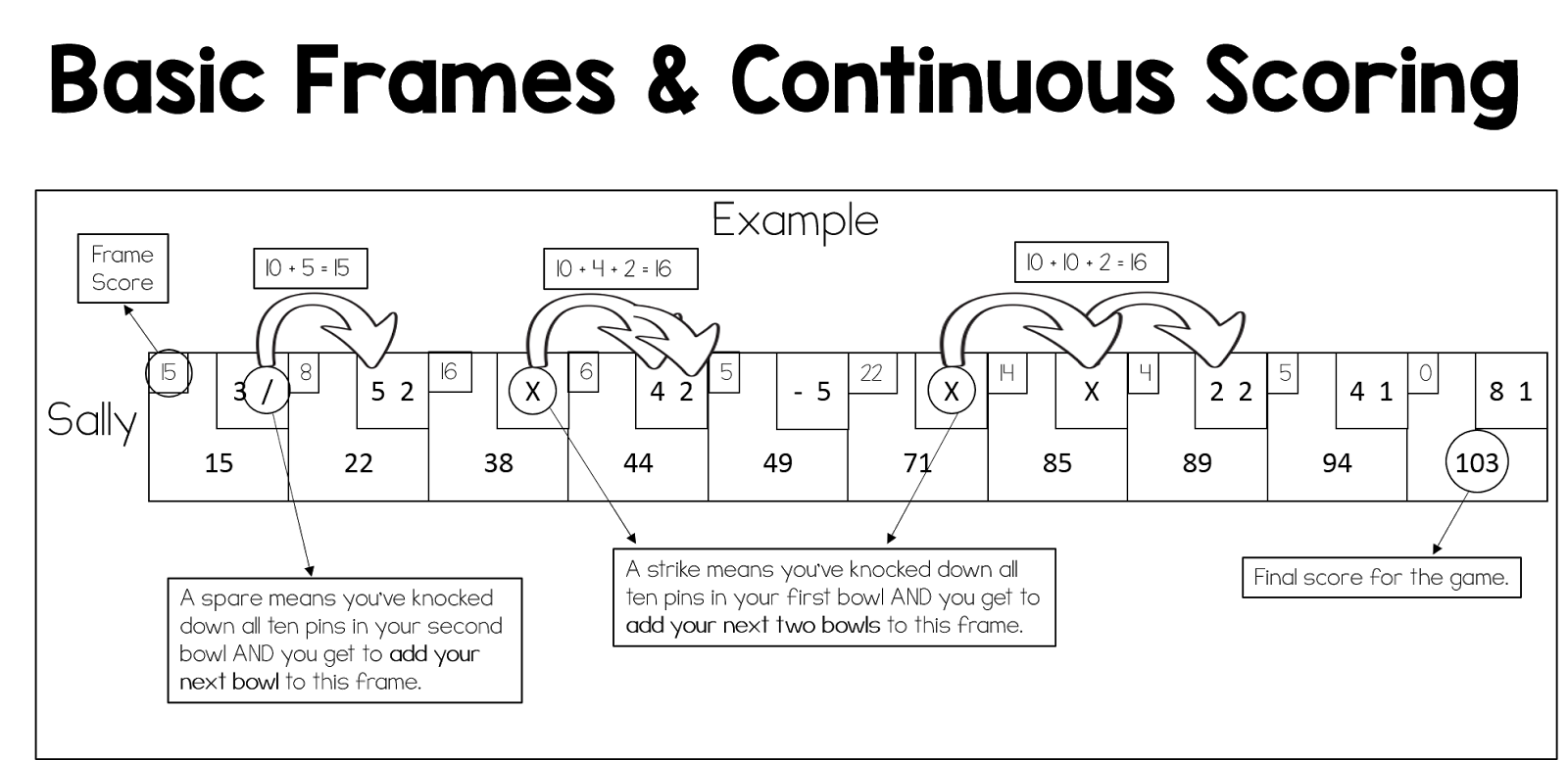
Students continue to work on stations, often returning to station they've struggled with. There is a station for every group and the general rule is that if a station is occupied, they must select another station. This is also the day I introduce manual scoring. Students often have no idea how scoring in this sport works because they've never had to track it themselves. I start by teaching basic frames and continuous scoring.
Introducing spares and strikes is often a skill I wait to introduce until seventh or eighth grade, but only you know your classes! If you think they can take those skills on sooner, I have this visual to assist students with understanding them.
Day 4 | Traditional Bowling, Manual Scoring Skills, Self-Assessment
On day four of my bowling unit, I take away the stations and let students practice their new skills in a traditional bowling environment. Students also keep track of their own scores and apply their scoring knowledge in a formative setting.
My role on day three is to facilitate feedback, assist with scoring, provide opportunities to challenge students, and collect/review bowling score cards. I print my scorecards from Print Your Brackets. They are easy to print and perfect for classroom use!
Day 5 | Summative Skill Assessment, Summative Manual Scoring Assessment
Day five is assessment day and I have been notifying my students about this every day leading up to it. My assessment style is informative and, in my opinion, always students to test in a comfortable environment without fear of making mistakes.
Skill Assessment: I allow students to pick their own groups and lane. I move to the students lane, inform them that I will be assessing their next bowl, notify them what I am looking for, and allow them two opportunities to find success. I place my criteria on an Excel Spread sheet with each students name pre-entered and fill in their results as I record them. I assess with a simple yes or no system. The individual skill is either present or not. If the skill is present, it is marked with a Y and if it is not present or incomplete, it is marked with a N.
Scoring Assessment: Students complete a pre-filled scoring sheet for four bowlers. I give my students the option on which scores they would like to tally. For example, in my assessment, I ask students to complete two of the four scores. They must score Corey or Emily as one of the two options and Michael or Patricia as the second option.
I also tell my students that if they want to work through all four, I will count their best two. I award one point per frame. I also grade based off the individual frames.
For example, if a student is working on Corey and scores 9 on frame one (correct), 19 on frame two (incorrect), and 27 on the third frame (half correct), they would earn two total points. They answered frame one correctly (+1), but answered frame two incorrectly (+0). They technically answered frame three correctly as the frame score is 8, but now they've based it off their incorrect score in frame two. They receive a point because they scored that frame correctly. You can access a copy of my scoring assessment and answer key for free in my store! While you're there you can also see my Bowling Classroom Newsletter to help keep parents updated on the latest class events!
And there you have it! This is how I like to run my own middle school bowling unit. Tell me what you think or show me how you run your own bowling unit! I love to see how other physical educators are teaching in their classrooms. If you have any questions, please don't hesitate to shoot me an e-mail at sassypeteach@gmail.com! Also be sure to follow me on twitter and instagram @sassypeteach as I'll be teaching my bowling unit over the next two weeks!
January 3, 2017
Athlete-Centered Coaching & Why It Matters for Our Student Athletes
Anyone who knows my educational background knows that I attended the University of Virginia for my graduate degree. While I was there I had the opportunity to meet many intelligent and talented individuals. I'm thankful to consider Marshall Milbrath a colleague, as well as a friend, and his latest research piece really spoke to me on multiple levels. In education, we hear about student-centered classrooms all the time. Many educators, especially at the middle and high school level, dedicate their after school time to impacting students in athletics as coaches. Too often I see this idea of student-based instruction and learning fade to the background when transitioning to the athletic field, but why? We know students are more engaged, enticed, and willing to learn when they have control of that learning, so why are we abandoning it on the sports field, especially when research is leading us to the same conclusion?
So how can we adjust our coaching styles to better our athletes in an athlete-centered environment right now?
While it has been suggested that research must continue to develop a working definition of athlete-centered coaching, common methods recognized as athlete-centered practices have been identified. This review describes some of these approaches taking into account scientific findings from a multitude of sports contexts, rationales for why these should be considered by the track coach in her or his practice, and recommendations for its implementation. - Milbrath (2017).If you really want to dive into the research behind athlete-centered coaching, I highly recommend reading Marshall's article (linked above), but for this post I want to talk about real athlete-centered strategies that middle and high school coaches can implement right now. Before we get there, it's important to understand what athlete-centered coaching is and Marshall summed it up like this, "The athlete-centered approach breaks away from negative articulations in coaching, while reducing the prevalence of autocratic, “win-at-all cost” mentalities common in many sporting contexts. Athlete-centered coaching adopts an attitude of facilitation and teaching. By focusing on teaching the mind, body, and spirit of the athlete, humanistic needs are fulfilled and athletes are empowered."
So how can we adjust our coaching styles to better our athletes in an athlete-centered environment right now?
- Understand Your Audience: Our athletes, their goals, the team atmosphere, and so many other factors change every year. If we want our approach to be athlete-centered, we have to adapt how we lead our team each year. Even if our team has many returning players, those few loses or new additions make it a completely different team. This leads into...
- Get to Know Your Athletes: Even at the middle school level, I use a short and simple personality test with each of my athletes. This accomplishes two major tasks, I get to know them and they get to know themselves. When athletes are more self-aware of their behaviors and goals, they can better advocate to us what they need. In the same token, it allows us as coaches to identify their strengths and weaknesses more efficiently, while gaining a better understanding of their learning styles.
- Be Purposeful: Every coaching decision you make in practice or in a game should be made with a specific purpose. This sounds like common sense, but I'm not just referring to decisions based on strategy and how to win games. Being purposeful in athlete-centered coaching is understanding the implications that decisions have on athletes and their mental, physical, and social well-being.
- Create a Team Philosophy: A philosophy is more than just a simple mission statement or expectations list for players. A philosophy tells your athletes, parents, and administration why your team has value. You can find an awesome sample list of coaching philosophies here. You can also find a wonderful article with advice on how to create your own unique coaching philosophy here.
- Set Goals: Perform this task on your own prior to the season and then sit down with your athletes to have them set their own. Be sure all goals are SMART (specific, measurable, attainable, realistic, and time-bound). Check in during set time frames to see how athletes are achieving goals and coach them through setbacks.
As we enter the spring coaching season, make small steps to move toward an athlete-centered mindset. You won't change your coaching style immediately, but small changes can have a large impact over time.
December 27, 2016
New Years Resolutions: How Do We Get Students to Buy In?
Christmas is over and most people are setting their sights on the future and that means New Year's Resolutions! We all know how hard it can be to stick to a resolution as adults so how on earth are we supposed to get our students to buy into goal setting and a fresh start!? Let's start with what we know and then come with a solution to the problem.
According to Forbes, it's estimated that more than 40 percent of Americans make some sort of New Year's Resolution annually. Of those resolutions, the top ten include three major health goals; losing weight (1), staying fit and healthy (5), and quitting smoking (7). In reality, it's estimated that only eight percent of individuals actually succeed in meeting their resolutions. We as educators may fall into this conundrum ourselves! So how do we set a good example for our students?
Keep It Simple. Too often, our resolutions involve a complete makeover of some aspect of our lives and too much change at one time is difficult to maintain. This is even more important for our students! When we talk to them about New Year's Resolutions and setting appropriate fitness goals, we also have to talk about what makes goals appropriate and attainable. Starting off with a goal of going to the gym for an hour everyday to improve muscular strength and endurance will not be attainable and sets the student up to fail. Instead, break the goal down and determine how often a student can realistically get to gym, how much time they can spend there, and what knowledge they have of weight training to successfully complete a workout. Ensure they take their goals home to discuss with a parent! Parental involvement is key for our students to succeed in any classroom, but especially when we look at impacting their lives outside of the classroom.
The Bottom Line... Keep goals simple to start and add on to them later once the simple goals have been met.
Develop a Plan Generic goals often fail because there is no specific criteria to hold us accountable. "I want to lose weight" or "I want to improve my cardiovascular endurance" are not sufficient resolutions because it provides no details in how to obtain them. It is critical to talk to students about SMART Goals (specific, measureable, attainable, realistic, and time-bound). Developing a plan to match your goal will help you stay motivated and hold you accountable. Help students develop plans in class to help obtain their goals. Provide feedback and suggestions before sending it home to show parents.
The Bottom Line... S.M.A.R.T guidelines for goal setting will help students develop a plan to increase their likelihood of success.
Check In Often. When students know that you have a vested interest in their goals and what they are trying to accomplish, they're more motivated to succeed. Schedule weekly, bi-monthly, or monthly check-ins to see how students are doing. This is an excellent opportunity to provide feedback, support, advice, modify goals, and to celebrate their accomplishments! You can even make up your own classroom achievement award to give to students who meet their resolutions.
The Bottom Line... Be there as a support for your students and celebrate their accomplishments!
Be a Role Model.The best way to motivate students is to show them how you're working on accomplishing your own resolutions. So long as you feel comfortable, share what your resolutions are with your students, check-in with them, and ask them to help reach your goals. I am only in my fourth year of teaching, but I have found that being honest and appropriately open with my students helps them feel safer in my classroom and more willing to share their own experiences. Goal setting and New Year's Resolutions provide the perfect opportunity to collaborate with students to reach common goals.
The Bottom Line... Be the example for your students.
No matter what resolutions you and your students may be embarking on for 2017, remember to follow this simple advice. Resolutions don't have to be overwhelming if they're thought out, organized, and attainable. Remember to go over SMART Goals with your students and check-in often. Many blessings to each of you as we enter 2017!
Keep in mind I am approaching this from a health and phys. ed perspective, but there ideas and guidelines can apply to many aspect of the educational experience.
According to Forbes, it's estimated that more than 40 percent of Americans make some sort of New Year's Resolution annually. Of those resolutions, the top ten include three major health goals; losing weight (1), staying fit and healthy (5), and quitting smoking (7). In reality, it's estimated that only eight percent of individuals actually succeed in meeting their resolutions. We as educators may fall into this conundrum ourselves! So how do we set a good example for our students?
Keep It Simple. Too often, our resolutions involve a complete makeover of some aspect of our lives and too much change at one time is difficult to maintain. This is even more important for our students! When we talk to them about New Year's Resolutions and setting appropriate fitness goals, we also have to talk about what makes goals appropriate and attainable. Starting off with a goal of going to the gym for an hour everyday to improve muscular strength and endurance will not be attainable and sets the student up to fail. Instead, break the goal down and determine how often a student can realistically get to gym, how much time they can spend there, and what knowledge they have of weight training to successfully complete a workout. Ensure they take their goals home to discuss with a parent! Parental involvement is key for our students to succeed in any classroom, but especially when we look at impacting their lives outside of the classroom.
The Bottom Line... Keep goals simple to start and add on to them later once the simple goals have been met.
Develop a Plan Generic goals often fail because there is no specific criteria to hold us accountable. "I want to lose weight" or "I want to improve my cardiovascular endurance" are not sufficient resolutions because it provides no details in how to obtain them. It is critical to talk to students about SMART Goals (specific, measureable, attainable, realistic, and time-bound). Developing a plan to match your goal will help you stay motivated and hold you accountable. Help students develop plans in class to help obtain their goals. Provide feedback and suggestions before sending it home to show parents.
The Bottom Line... S.M.A.R.T guidelines for goal setting will help students develop a plan to increase their likelihood of success.
Check In Often. When students know that you have a vested interest in their goals and what they are trying to accomplish, they're more motivated to succeed. Schedule weekly, bi-monthly, or monthly check-ins to see how students are doing. This is an excellent opportunity to provide feedback, support, advice, modify goals, and to celebrate their accomplishments! You can even make up your own classroom achievement award to give to students who meet their resolutions.
The Bottom Line... Be there as a support for your students and celebrate their accomplishments!
Be a Role Model.The best way to motivate students is to show them how you're working on accomplishing your own resolutions. So long as you feel comfortable, share what your resolutions are with your students, check-in with them, and ask them to help reach your goals. I am only in my fourth year of teaching, but I have found that being honest and appropriately open with my students helps them feel safer in my classroom and more willing to share their own experiences. Goal setting and New Year's Resolutions provide the perfect opportunity to collaborate with students to reach common goals.
The Bottom Line... Be the example for your students.
No matter what resolutions you and your students may be embarking on for 2017, remember to follow this simple advice. Resolutions don't have to be overwhelming if they're thought out, organized, and attainable. Remember to go over SMART Goals with your students and check-in often. Many blessings to each of you as we enter 2017!
December 19, 2016
Teachers Pay Teachers Holiday Linky Party!
To quote one of my favorite holiday films, "The best way to spread Christmas cheer is singing loud for all to hear!" Clearly Buddy the Elf wasn't a Teachers Pay Teachers seller because we all know the best way to spread Christmas cheer is by sharing resources for all to hear (er, see).
With that being said, let's get right to the main event. I am launching my first {ever} Linky Party! I have participated in many amazing Linky's in the past and I'm thrilled to be able to host my first one with you all.
For this linky I am asking all participants to post one FREE holiday themed resource and one PAID holiday themed resource. They can be Christmas, Hanukkah, Kwanzaa, or general winter themed. Once you have posted your two links, I humbly ask you to share this post with friends, fellow teachers, and other Teacher Pay Teachers sellers! A special thank you to Ashley Hughes for the border frame and clip art used for the graphic on this post.
If you would like to make this Link Up extra special, I ask you to choose one of the following causes {or a cause of your own} to donate to when you download a free resource. Each of these causes has a special place in my heart!
With that being said, let's get right to the main event. I am launching my first {ever} Linky Party! I have participated in many amazing Linky's in the past and I'm thrilled to be able to host my first one with you all.
For this linky I am asking all participants to post one FREE holiday themed resource and one PAID holiday themed resource. They can be Christmas, Hanukkah, Kwanzaa, or general winter themed. Once you have posted your two links, I humbly ask you to share this post with friends, fellow teachers, and other Teacher Pay Teachers sellers! A special thank you to Ashley Hughes for the border frame and clip art used for the graphic on this post.
If you would like to make this Link Up extra special, I ask you to choose one of the following causes {or a cause of your own} to donate to when you download a free resource. Each of these causes has a special place in my heart!
Let's get this Linky Started!
December 13, 2016
Giving Thanks & Tips to my {100} Followers!
As a way to say thank you to everyone who has supported me throughout this process, I have a new, free product available in my store! I'll give a little more detail on this later on.
Teachers Pay Teachers has been such a wonderful outlet for me over the past year. I've always thought I wasn't a creative person or that artistic things weren't for me and TpT has showed me how wrong I was! This journey hasn't just been about selling products, although that has certainly been an added benefit. Becoming a TpT seller has made me a better teacher in my classroom! If I'm teaching a lesson I think to myself, if I made this lesson would someone want to buy it? If the answer is yes, woo hoo! If the answer is no, then why am I teaching this way? Is it benefiting my students? Is is keeping them engaged? How can I make this better for them? It truly makes me think about how I am delivering content and to challenge the status quo!
My department has noticed these changes, as has my administration! My co-workers will even come to me with ideas they've done in their own classrooms and say, "You should make this for your store!" I'll go to them and say I've made a new resource and I want to try it out with our classes before posting it for sale and they always say yes. I could not be more blessed to have so much support for what I'm doing.
With all of this being said, I wanted to share some tips and tricks I've learned from so many amazing sellers along the way for any educators who are interested in becoming a TpT seller or who are just getting started.
- Become a Premium Seller - Immediately: I read this everywhere and thankfully listened! I purchased my membership on January 16, 2016 and it was scary. I hadn't sold a single product, but everyone was advising that it would pay for itself in the first month. They were right! In my first real month of sales (February 2016) I sold $122 worth of products and took home $103.39 in earned income. If I had still been a basic seller, I would have earned $61. Going premium is worth every penny!
- Get on the Forums: The TpT Forums are without a doubt the best thing that ever happened to me as a new seller! There is so much information here to read up on. You can ask your own questions, introduce yourself, connect with other sellers, and so much more! Be sure to read through before asking a question though, there is a very good chance the information is already there!
- Invest in Versatile Clip Art: Another tip I received was to pay for quality clip art. There is a lot of clip art that you can get for free, but having the improved quality for a small selection when you first get started is incredibly helpful! I invested in sports themed clip art and have used it in so many of my resources since then. Find what clip art you think you'll use the most and make the purchase. I have many sellers who I revisit because I love their work so much!
- Invest in Font Options: There are a tone of sellers who makes fonts, but let me save you some time and money. Kimberly Geswein is the only font store you will ever need. She was everything. When you see a font other sellers are using an you think to yourself, where did they get that!? I will bet you 9.9 out of 10 times, it's from Kimberly Geswein. You can download all of her fonts for free for personal use only. She then offers font licenses to purchase for $5 which allows you to use her font in your TpT products. Now, this is the good part. She offers a lifetime all fonts license for $299. Don't have $299 sitting around? If you purchase 60 single font license for $5, contact her so she can verify your purchases, and she will give you her all fonts license. Basically, she's offering you a payment plan! She offers a free font pairing guide to help show you how to pair fonts for a good visual aesthetic. She is awesome!
Note: I'm working on my payment plan as we speak {slowly, but surely}... I can't wait to have unlimited use of her fonts! In order to use this method effectively (or if you've already purchased single font licenses) you'll need to purchase additional single font licenses. Do not purchase the $299 all font license at one time if you've already purchased a single font license, because you'll essentially be losing what you've already paid for. For example, I personally have purchased six single use font licenses. I would want to pay for 54 more individual licenses and contact Kimberly instead of buying the $299 license because I would be losing $30 I've already paid. - Hold Off on Social Media: Everyone I spoke to advised me to hold off on social media and I didn't listen. I tried to pin, tweet and blog immediately after becoming a seller and it was a mistake. I was overwhelmed trying to keep up with everything and I believe that my sales and product line suffered because of it. I am a just shy of a year in now and I've just started utilizing social media to the fullest! My blog is updated weekly, I tweet and post to Instagram what my classes are doing daily, and I can Pinterest like a pro! I would recommend having 10-15 solid resources in your store before you start utilizing Pinterest, 30-40 solid products before using twitter, and waiting until you feel comfortable utilizing your products in your classroom before moving on to Instagram and Facebook.
- Understand Copyright Laws: I did a lot of research on copyright and trademark laws before creating my products. There is a ton of information out there and it is important to the integrity of your work, as well as the integrity of Teachers Pay Teachers. It's also very frustrating for those of us who know what the laws say to scroll through TpT and see blatant violations everywhere. If there is something popular with kids that is produced or manufactured by a major company, it's likely copyrighted or trademarked. Just because you see someone else selling it on TpT, doesn't mean it's okay or legal. Teachers Pay Teachers offers help directly from their site here.
- Make Good Covers & Brand Yourself: This is important on TpT for many resources! When potential buyers are scrolling through a long search for a product you want to be able to catch their eye! Colorful, easy to read covers are an excellent way to entice buyers to view your product. Be consistent with your covers so buyers know, "Oh, that's a {insert seller} product!"
- Find Your Niche: Find what you are passionate about when thinking of products for your store! If you try to make products about things you're not knowledgeable or experienced in, it will show in the product. Don't try to fit into the crowd, make resources you can make well regardless of what category that places you in!
- Purchase a Seller's Kit or Binder: Let's be honest here, if you're new to TpT or thinking about becoming a seller, you likely have no clue what you're doing. I certainly didn't! There is nothing wrong with being new and purchasing a sellers kit or binder is so helpful! I purchased mine here and it has kept me so organized! I can track my sales by month, quarter, and year round. I can track what I've purchased, what I want to blog, I can plan out resources and units, and so much more.
- Understand TpT Etiquette & Common Decency: You're going to log in and see so many great ideas! Maybe you've been a buyer and you've decided to create your own store or maybe you're scrolling through the search for inspiration. Whatever you're doing it's important to ensure you're not just re-making other sellers resources and selling them as your own! All of your products should be your own unique creation that add to what the rest of the community has already created, not a copycat that hurts other sellers.
- Read the Terms of Service Agreements: Every seller should have a terms of service (TOS) agreement within their downloads. Read them. Clip art especially has specific conditions for using that source in other products you create. Read them carefully and follow their instructions so you are not violating their TOS.
- Make a Terms of Service Agreement: Protect your work and include a TOS agreement with every product download. This allows you to back up a claim made against another seller if you ever need to. Not only that, it helps buyers understand what your rules are so they can use your resources appropriately.
There are many more tips I can provide, but I believe this is a good base for anyone just getting started. I have learned so much along this journey and if you're considering selling on TpT I highly recommend it! If you ever want to ask me specific questions, please feel free to e-mail me at sassypeteach@gmail.com.
As a thank you to my followers, check out my latest freebie here. I hope you enjoy utilizing these frames in your future TpT creations!
December 6, 2016
VAHPERD Review Series Part 4: The Brain Game Challange
I am so excited to share my final session review from the 2016 VAHPERD Conference! This presentation was created by Andrea Samsky and I have to say that there is not a more creative person teaching HPE in this universe! For example, when she teaches soccer in class, every piece of equipment takes on a role in the circulatory system (i.e. the balls are oxygen) and she utilizes these pieces to teach two or more concepts at once. My mind was truly blown! I could have stayed and talked to her for HOURS to listen to all of the ways she incorporates health concepts into the PE realm for her elementary students. If you are ever in search of creative ideas for your HPE classroom, reach out to Andrea, she is phenomenal!
Well now that you've heard about how wonderful Andrea is, let me give you all the skinny on what she taught us at VAHPERD to prove it! This lesson was created for elementary students, but after going through it with her, these can easily be adapted to fit the middle school classroom. This activity is called the Brain Game Challenge and works with a station system and worksheet to get kids building, moving, and learning throughout the classroom. I did mark this as a freebie, but there are components you will need before taking this into class and I'll warn you, it requires some work, but the payoff is worth it!
Equipment:
Setup:
Well now that you've heard about how wonderful Andrea is, let me give you all the skinny on what she taught us at VAHPERD to prove it! This lesson was created for elementary students, but after going through it with her, these can easily be adapted to fit the middle school classroom. This activity is called the Brain Game Challenge and works with a station system and worksheet to get kids building, moving, and learning throughout the classroom. I did mark this as a freebie, but there are components you will need before taking this into class and I'll warn you, it requires some work, but the payoff is worth it!
Equipment:
- Pool noodles cut into 1/2 inch sections (approximately 23 per group)
- Rope (approximately 24-36 inches long) per group
- Printed worksheets (one per group)
- Pens/Pencils (one per group)
- Station Cards
- Cones (one per station)
- Hula Hoops (one per group)
Setup:
- Stations should be spread apart around the outside of your safe space with all necessary equipment.
- Each group should find a hula hoop with their equipment placed inside of it.
Recommendations:
- If possible, try to keep group sizes between 3-5 so students are actively involved.
- Number your station cards so they match the question on the worksheet. You don't want students spending five minutes at a station sitting and staring at the worksheet trying to figure out where the answer is - keep it simple for them.
- Avoid making every individual child fill out their own sheet - it keeps them still for longer bouts of time.
- Move around throughout the activity and check on student learning and retention.
- Review at the end of class while keeping kids active.
If you would like to see the PDF files of her station cards or worksheet, please shoot me an e-mail at sassypeteach@gmail.com. If you know of an easy way to upload those files directly to blogger as a PDF, please let me know! I'm still learning and can admit, I'm not sure of the best way to get you that information. You can see in the sample below that the set she gave us is for lower elementary! Over Christmas break, I will be working on a middle school version for those of us who may be interested!
Don't forget to submit your ideas for my TpT store by December 20! E-mail sassypeteach@gmail.com with your submissions and check out the entries and rewards post here! Until next time :)
Subscribe to:
Comments (Atom)